
Updated: 4 November 2026
NDIS goals examples can include preparing a simple meal, taking part in a morning routine or joining a community activity. Start with what matters to you, choose a small step and practise with the assistance you need. Goals guide planning but do not guarantee funding.
Everyone has things they would like to achieve.
For some people, this might mean learning to cook a favourite meal. For others, it could involve becoming more comfortable travelling to familiar places, developing a daily routine or making new friends.
When you are an NDIS participant, these personal ambitions can become part of your NDIS goals.
However, setting a goal is only the beginning.
Understanding how to turn that goal into everyday activities can help make progress feel more manageable and meaningful.
At Enable Life Disability Services, we believe support should begin with understanding what matters to each person.
This guide explains how participants can set meaningful NDIS goals, break them into practical steps and recognise progress along the way.
What are NDIS goals?
NDIS goals describe things you want to work towards in your life.
They may relate to everyday living, independence, social connections, communication, mobility, work, study or developing new skills.
The NDIA says goals can be small or large, short-term or long-term. They may also be specific, such as learning to prepare meals, or broader, such as becoming more independent.
Your goals should reflect what matters to you.
They do not need to sound complicated or technical.
A useful goal can simply describe something you would like to improve, try or participate in.
It is also important to understand that having a goal does not automatically mean the NDIS will fund a particular support.
Goals help inform planning decisions, but funded supports still need to meet the relevant NDIS requirements.
Why are everyday goals useful?
Large goals can sometimes feel difficult to achieve.
Breaking them into smaller activities can make progress easier to understand.
For example, someone who wants to become more confident preparing meals may start by:
- choosing a simple recipe,
- identifying ingredients,
- helping prepare one part of the meal,
- gradually becoming more involved over time.
Progress does not always mean completing an activity independently.
It can also mean:
- making more choices,
- feeling more confident,
- learning part of a new task,
- communicating preferences,
- participating more actively.
The most meaningful progress is progress that matters to the participant.
NDIS goals examples: five practical ideas
These examples are general ideas, not official templates or guarantees of funding.
Use these NDIS goals examples as conversation starters. Adapt each idea to your interests, starting point and support needs.
1. Becoming more involved in daily personal activities
Example goal:
“I want to become more involved in my morning routine.”
Possible practical steps might include:
- choosing clothing,
- organising personal belongings,
- helping prepare items for the day,
- completing part of a personal routine with the appropriate level of assistance.
For someone receiving Daily Personal Activities support, the focus may be on increasing involvement and choice rather than removing support altogether.
2. Developing household skills
Example goal:
“I want to build practical skills so I can participate more in managing my home.”
This might involve:
- sorting laundry,
- following a simple cleaning routine,
- organising groceries,
- learning how to complete part of a household task.
Enable Life’s Household Tasks Support and Development of Daily Living Life Skills services may be relevant where these activities form part of agreed support arrangements.
3. Building confidence with travel
Example goal:
“I want to feel more confident travelling to familiar places.”
Practical steps might include:
- learning a regular route,
- recognising familiar landmarks,
- planning what to take on a journey,
- practising how to ask for help,
- gradually increasing confidence in familiar travel situations.
Some participants may always need support during travel. Others may be working towards completing parts of a journey with less assistance.
Success looks different for everyone.
4. Participating more in the community
Example goal:
“I want to take part in more activities I enjoy and meet people with similar interests.”
A participant might begin by:
- identifying an activity they enjoy,
- visiting a local venue,
- attending a small or familiar activity,
- gradually participating more regularly.
Community participation could involve libraries, recreational activities, social groups, hobbies or other interests.
Enable Life’s Community Participation service focuses on helping people engage in meaningful activities that match their preferences and agreed support needs.
5. Learning practical daily living skills
Example goal:
“I want to learn how to prepare simple meals with the level of assistance I need.”
Possible steps might include:
- choosing meals,
- making a shopping list,
- identifying ingredients,
- learning one preparation step,
- following a simple routine.
Other daily living goals might involve planning a schedule, organising belongings or developing routines that support greater independence.
Turning NDIS goals examples into practical steps
A simple approach is:
1. Identify what you want to achieve.
Choose something meaningful to you.
2. Think about your starting point.
Consider what you can already do and what assistance you currently need.
3. Choose one realistic next step.
You do not need to work on everything at once.
4. Decide what progress might look like.
Progress could mean feeling more confident, participating more often, completing another step or needing a different level of assistance.
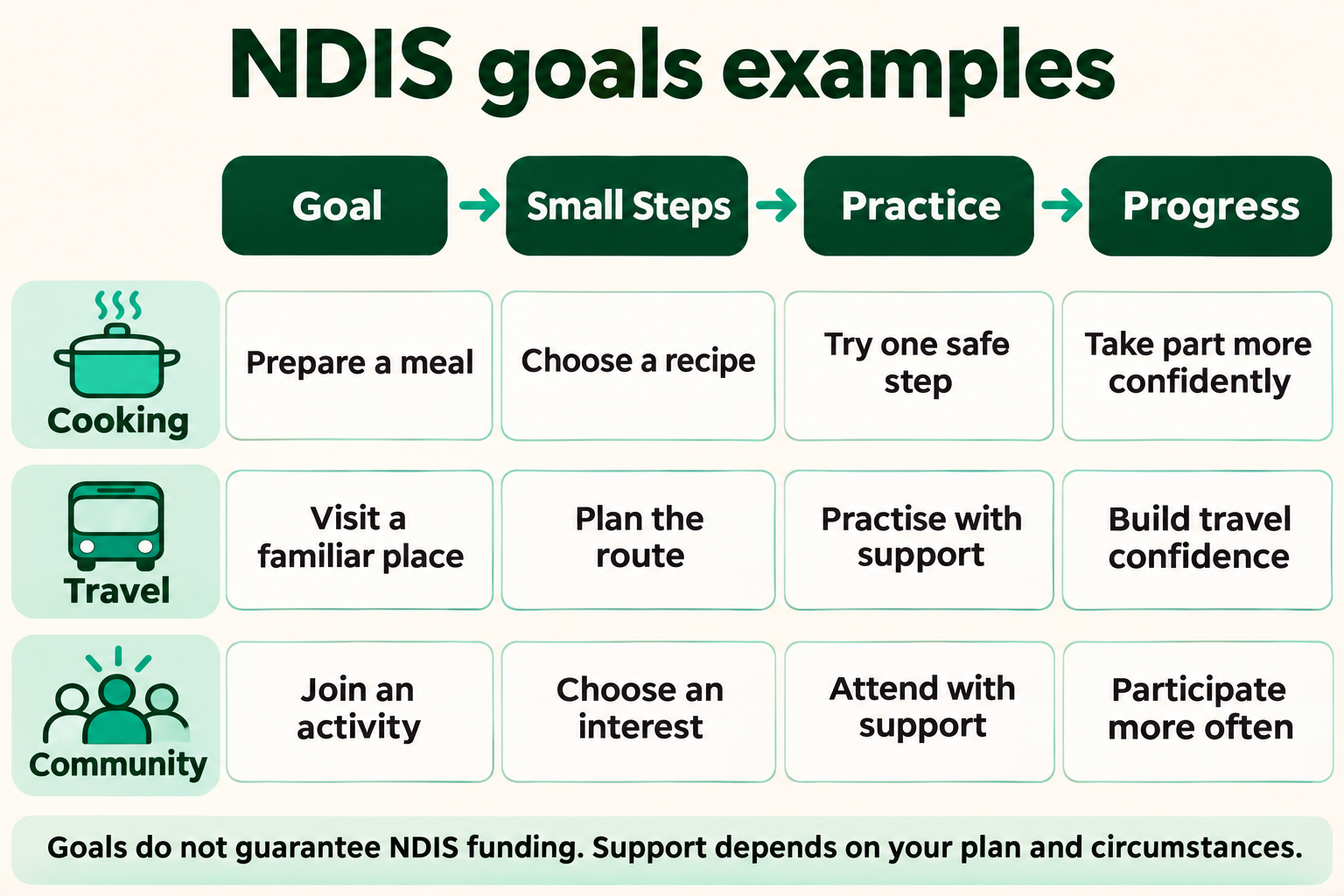
For example:
Goal: Become more confident preparing meals.
Starting point: You currently need assistance with most meal preparation.
First step: Choose one simple meal.
Next step: Practise one safe preparation activity.
Progress: You become more comfortable taking part in additional parts of the task.
How can you track progress?
Tracking progress can help participants recognise achievements that may otherwise be easy to overlook.
You might use:
- a simple checklist,
- notes,
- photographs where appropriate and consented to,
- a visual schedule,
- conversations with family or support workers,
- a record of activities you have tried.
For example, someone working towards community participation might record:
- which activities they attended,
- which activities they enjoyed,
- what support helped,
- what they would like to try next.
When adapting NDIS goals examples, choose a way to record progress that suits you. A checklist or a short conversation may be enough.
The purpose is not to create unnecessary paperwork.
It is simply to help recognise what is working and what might need to change.
Putting NDIS goals examples into everyday practice
The following is a hypothetical example, not a participant testimonial or a funding recommendation.
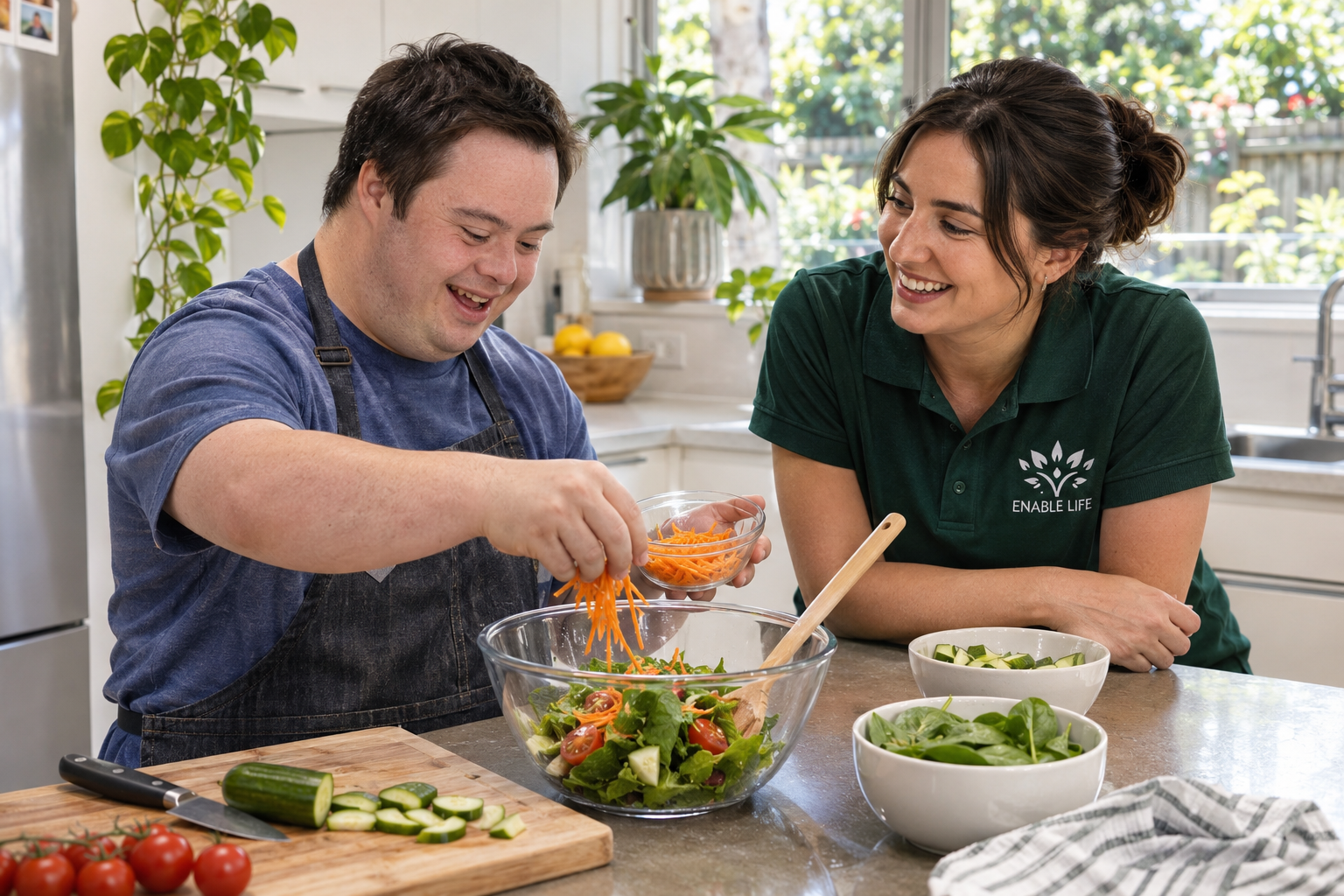
Alex enjoys sharing meals with family and wants to take a larger role in preparing dinner. Alex already chooses favourite foods and helps put ingredients on the bench, but needs assistance to follow a recipe and use kitchen equipment safely.
The goal is not to cook an entire meal alone. Alex wants more choice and involvement, with the level of support that makes the activity comfortable and safe. This distinction helps everyone recognise progress without treating independence as an all-or-nothing outcome.
Agree on one manageable activity
Alex and the support worker choose a familiar salad. Before starting, they discuss which parts Alex would like to try, which tasks need assistance and how to ask for a break. Any relevant professional instructions and individual safety needs should guide the activity.
For the first session, Alex chooses two ingredients and places washed vegetables in a bowl. At the next session, Alex may repeat the same activity or try another agreed step. There is no requirement to increase the difficulty each time.
Notice what helped
Afterwards, the worker asks Alex what felt enjoyable and what was confusing. Alex might prefer a picture of the finished meal, fewer ingredients on the bench or more time between instructions. Record those preferences so the next session can build on them.
A short progress record could include:
- What I chose: the meal and ingredients I wanted to use.
- What I tried: the part of preparation I took part in.
- What helped: prompts, equipment, time or assistance that worked for me.
- What I want next: repeat the activity, try a small change or choose something different.
Review the goal with the participant
After several sessions, progress might mean Alex starts choosing ingredients more confidently, asks for assistance sooner or enjoys taking part more regularly. Those achievements can matter even when the same amount of practical assistance is still needed.
The same approach can help adapt NDIS goals examples for travel or community activities: identify a meaningful choice, agree on one step, practise with suitable support and discuss what happened. The participant should remain involved in deciding whether the next step feels right.
Keep the activity plan separate from assumptions about funding. Before arranging paid support, confirm the agreed service, costs and how the support fits the participant’s own plan. The NDIA explains that working towards a goal is only one part of a funding decision.
Can NDIS goals change?
Yes.
The NDIA says participants can change their goals when their priorities or circumstances change.
A small update to goals can generally be made through a plan variation rather than requiring an entirely new plan.
You may want to change a goal because:
- you achieved it,
- your interests changed,
- your circumstances changed,
- you want to work towards something new,
- the previous goal is no longer relevant.
Changing a goal by itself does not automatically increase your NDIS funding.
How to prepare your goals for an NDIS conversation
Before a plan meeting or check-in, it can help to think about:
- what is working well,
- what you would like to change,
- what activities are important to you,
- what you would like to learn,
- what you want to participate in more often,
- which supports are helping you work towards your goals.
The NDIA recommends writing goals in your own words where possible. Your planner can also help record them during the planning process.
How Enable Life can support everyday goals
Enable Life Disability Services provides practical support across five areas:
Daily Personal Activities
Assistance with agreed everyday personal routines.
Household Tasks Support
Support with practical household activities such as cleaning and laundry.
Assistance in Travel and Transport
Support with agreed journeys and travel arrangements.
Development of Daily Living Life Skills
Help with learning and practising everyday skills.
Community Participation
Support to participate in community activities and develop interests.
The right support should reflect the participant’s own goals, preferences and circumstances.
For questions about NDIS funding decisions or plan changes, participants should contact the NDIA or their appropriate plan-management contact.
Contact Enable Life Disability Services
If you would like to discuss support for everyday activities, building skills or participating in the community, contact Enable Life Disability Services.
Phone: 03 7020 4849
Email: support@enablelife.com.au
Website: enablelife.com.au
Frequently Asked Questions
1. What is a good example of an NDIS goal?
A good goal describes something meaningful you want to work towards, such as becoming more involved in household tasks, building confidence in the community or developing everyday living skills.
2. Does every NDIS goal have to be about independence?
No. Goals can relate to many parts of life, including relationships, community participation, work, study, daily routines and maintaining existing abilities.
3. Does having an NDIS goal guarantee funding?
No. Goals help inform planning, but funded supports still need to meet NDIS requirements.
4. Can I change my NDIS goals?
Yes. The NDIA allows participants to update their goals when their priorities or circumstances change.
5. Do goals have to be large?
No. The NDIA says goals can be small or large, short-term or long-term.
This article provides general information as at 4 November 2026. It does not replace advice about an individual NDIS plan or funding circumstances.
Official NDIA guidance on goals and funding
Read the NDIA guidance behind these NDIS goals examples:
- NDIS — How to set goals: choosing goals and recording them in your own words.
- NDIS — What are goals?: why a goal does not guarantee funding.
- NDIS — How to change your goals: plan variations and the limits on funding changes.