

29 October 2026
If you receive support through the National Disability Insurance Scheme (NDIS), understanding how support prices work can help you make informed decisions about your services and budget.
The National Disability Insurance Agency (NDIA) has announced that maximum prices for four NDIS support items will increase from 1 December 2026.
The changes include certain household assistance and personal domestic support services.
But does this mean your support provider will automatically charge you more? Will your NDIS funding increase? And what should you check before December?
Here’s what participants and families need to know.
What are the new NDIS price changes?
On 19 October 2026, the NDIA announced upcoming changes linked to the Fair Work Commission’s review of gender-based wage undervaluation under the Social, Community, Home Care and Disability Services Industry Award.
The changes increase the maximum amount that can be charged under four specific NDIS support items.
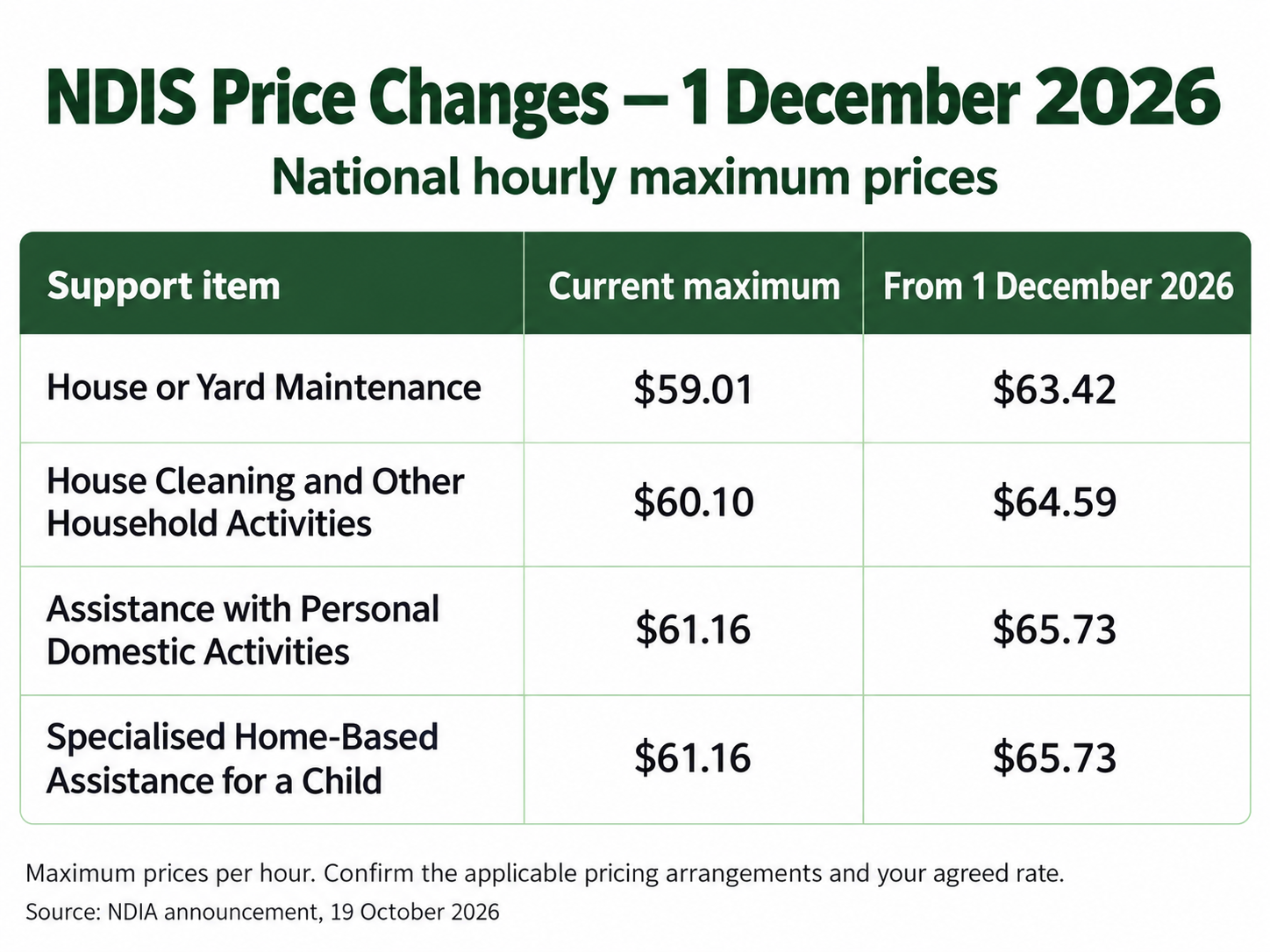
The revised national hourly price limits are:
| NDIS support item | Current maximum | From 1 December 2026 |
|---|---|---|
| House or Yard Maintenance | $59.01 | $63.42 |
| House Cleaning and Other Household Activities | $60.10 | $64.59 |
| Assistance with Personal Domestic Activities | $61.16 | $65.73 |
| Specialised Home-Based Assistance for a Child | $61.16 | $65.73 |
These are the national rates published in the NDIA’s announcement. The precise applicable price must be checked against the relevant pricing arrangements.
The revised limits apply to eligible supports delivered on or after 1 December 2026. The support item numbers and claiming process are not changing.
Does this mean every NDIS participant will pay more?
No.
The announcement increases the maximum permitted prices for specific support items. It does not require every provider to charge the maximum.
For participants with NDIA-managed or plan-managed funding, providers and participants can negotiate an appropriate price up to the applicable maximum.
Self-managed participants have different pricing arrangements and should check the rules relevant to their funding arrangements.
Importantly, a higher maximum price does not mean your existing service agreement automatically changes.
The NDIA states that providers must discuss proposed changes to existing service agreements resulting from the new prices, and participants must agree before those changes are made.
If your provider proposes an increase, you can ask for a clear explanation of the new rate and when it would apply.
How could this affect household support?
Household assistance is important for many NDIS participants who need disability-related support to maintain their home and everyday routines.
Depending on a participant’s approved plan and individual needs, support may involve assistance with:
- Cleaning and maintaining living spaces.
- Laundry and other household tasks.
- Personal domestic activities.
- Developing practical routines for everyday living.
The announced price changes directly reference House Cleaning and Other Household Activities and Assistance with Personal Domestic Activities.
However, it is important to check the specific NDIS support item being used.
A service described generally as household assistance does not necessarily use the same support item in every situation.
Participants should ask their provider to confirm which support item applies to their agreed service.
Will the NDIS increase my plan funding automatically?
A change to a maximum price is different from a change to the total funding approved in an individual NDIS plan.
The October pricing announcement does not itself confirm an automatic increase to every participant’s plan budget.
If you receive regular household assistance and your provider proposes a higher hourly rate, it is sensible to consider how the proposed charges would fit within your remaining funding.
For example, a person receiving regular cleaning assistance might want to check how many support hours their remaining budget could cover at the agreed rate.
You can review your budget through the my NDIS app or participant portal. The NDIA also provides budgeting resources to help participants estimate support hours and expenses.
Five things to check before 1 December 2026
You do not need to make changes simply because the NDIA has announced new price limits.
However, preparing before the effective date may help you avoid confusion.
1. Check your current service agreement
Review the hourly rate you have agreed to pay and any provisions concerning changes to prices.
2. Ask whether your support item is affected
The announcement applies to four specific support items. Ask your provider which item number is used for your service.
3. Confirm any proposed new charges
If your provider intends to change its rates, ask for the proposed amount and effective date.
4. Review your available funding
Check your remaining NDIS budget and consider whether proposed changes may affect your planned support hours.
5. Discuss arrangements before agreeing
If you are uncertain about a change, ask questions. You can involve someone you trust or speak with your plan manager or my NDIS contact, as appropriate.
Clear communication can make it easier to plan supports around your needs.
What about travel, community participation and daily living skills?
The October announcement identifies four specific NDIS support items.
It does not announce a general price increase across every type of NDIS support.
Participants receiving Assistance in Travel and Transport, Community Participation or Development of Daily Living Life Skills support should therefore avoid assuming that all their services will become more expensive.
Instead, check the relevant support item, applicable pricing arrangements and agreed rate for each service.
This is particularly important where participants receive a combination of different supports throughout the week.
New NDIS service agreement resources are available
There is another recent development that may help participants understand their rights and responsibilities.
On 13 October 2026, the NDIA released new resources to support clearer service agreements.
These include a service agreement template, checklist, guidance and Easy Read materials.
The resources are intended to help participants and providers understand what has been agreed, including the services being provided and their associated arrangements.
The NDIA confirms that its new template is optional. Participants and providers choosing to use it should adapt it to their circumstances.
You can access the announcement and resources through the official NDIS website.
How Enable Life supports everyday independence
At Enable Life Disability Services, we understand that reliable everyday assistance can make an important difference to independence, confidence and wellbeing.
We provide person-centred disability support across Melbourne, including:
Daily Personal Activities: Assistance with agreed personal routines, such as getting ready, personal hygiene, dressing and mealtimes.
Household Tasks Support: Practical assistance with cleaning, laundry, meal preparation and everyday household routines.
Assistance in Travel and Transport: Support with agreed journeys to appointments, activities and other destinations.
Development of Daily Living Life Skills: Opportunities to learn and practise skills that support everyday independence.
Community Participation: Support to access community activities, develop interests and build social connections.
Our approach focuses on understanding individual preferences, goals and the practical assistance each person needs.
If you are considering support services, our team can discuss the available arrangements, proposed charges and next steps.
For questions about NDIS funding decisions or your approved budget, participants should contact the NDIA or their appropriate plan-management contact.
Speak with Enable Life Disability Services
If you or a family member is looking for disability support across Melbourne, Enable Life can discuss your individual requirements.
Whether you need assistance with personal routines, household activities, community access or building daily living skills, understanding your options is an important first step.
Contact Enable Life Disability Services
Phone: 03 7020 4849
Website: enablelife.com.au
Email: support@enablelife.com.au
Our team can discuss your support needs and the arrangements available.
Frequently Asked Questions
1. When do the new NDIS prices start?
The revised maximum prices for the four announced support items apply to eligible services delivered on or after 1 December 2026.
2. Will all NDIS support workers charge more from December?
Not necessarily. The announcement increases maximum prices for specific support items. Actual charges depend on the applicable pricing rules and the arrangements agreed between a participant and provider.
3. Can my provider increase the rate without discussing it with me?
The NDIA states that providers must discuss proposed changes to existing service agreements resulting from these price changes, and participants must agree before the changes are made.
4. Does the price increase mean I will receive more NDIS funding?
Not automatically. The announcement concerns support price limits rather than a general increase to every participant’s approved funding. Check your individual budget and seek clarification if needed.
5. Where can I find the official NDIS price announcement?
The NDIA published the announcement on 19 October 2026. You can read it on the official NDIS website.
Read the official NDIS price increase announcement
Information correct as at 29 October 2026. This article provides general information and should not replace advice about an individual’s NDIS plan or circumstances.